History
Brief information about the activities of the joint research laboratory "Problems of Artificial Intelligence" of the Academy of Sciences of the Republic of Tatarstan and Kazan State University (SNIL, ANT and KSU) within the framework of the "State Program for the Preservation, Study and development of the languages of the peoples of the Republic of Tatarstan" (1994-2001)
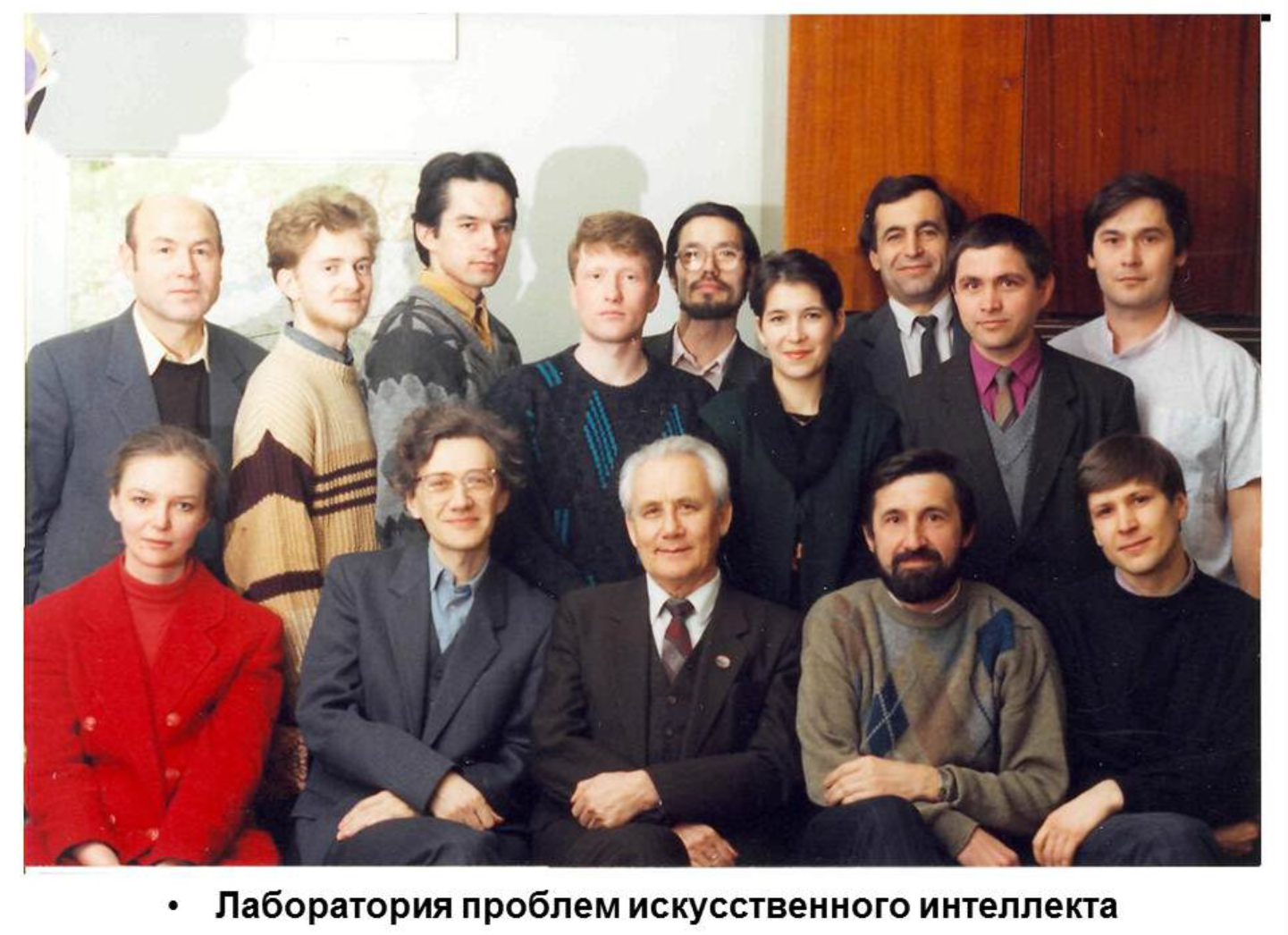
SNIL PII ANT and KSU (scientific supervisor, Doctor of Physico-Mathematical Sciences, Doctor of Technical Sciences, Professor R.G. Bukharaev, Head of the laboratory. Doctor of Technical Sciences, Associate Professor Suleymanov D.S.) was established on July 1, 1993 to conduct fundamental research and applied work in the field of computational linguistics, to solve problems within the Scientific and Applied Program of the Academy of Sciences of the Russian Academy of Sciences until 2005 "Computer support of the functioning of the Tatar language as the state language. A conceptual and algorithmic model" and for creating computer support tools for the Tatar language as the state language within the framework of the State Program of the Republic of Tatarstan for the preservation, study and development of the languages of the peoples of the Republic of Tatarstan.
SNIL ANT and KSU is an expert organization for the introduction of the Tatar language into computer technologies (Resolution of the Council of Ministers of the Republic of Tatarstan No. 1062 dated December 9, 1996) in the Republic and the basic laboratory for the implementation of section VI "Introduction of information technologies in the system of measures to ensure the functioning of the Tatar language" of the State Program for the Preservation, Study and Development of the Languages of the Peoples of the Republic of Tatarstan.
Field of activity
The scientific problems of the laboratory are the study of artificial intelligence problems, the development of principles and methodologies for the synthesis of an intelligent human-machine interface. The main focus is on the tasks of communicating with a computer in natural language. These studies began with work on semantic analysis and logical-mathematical modeling of algorithms for human-machine dialogue in problematic dialects of natural language. (See the monograph Bukharaev R.G., Suleymanov D.Sh. "Semantic analysis in question-answer systems", Kazan, KSU, 1990.)
This methodology is based on the principles of "context management," "expected meaning," and "openness of multiple classes of contexts." The effectiveness of their use was confirmed by the creation of experimental linguistic processors and their use in testing students' knowledge by computer in a question-and-answer mode. Work continues in the direction of studying and modeling the processes of encoding and recognizing meaning under the conditions of the above-mentioned three principles.
The second area of research in the field of artificial intelligence relates to the study of cognitive mechanisms of grammar generation and speech generation. If the first direction deals with an established (but alive) While language studies the patterns of generating and recognizing the meaning of specific texts, the second direction studies the processes of language formation as a cognitive tool that effectively reflects the world of things in all its manifestations. (See Nevzorova O.A. "A formal model for the reconstruction of morphological categories of natural language based on texts" — PhD thesis).
The laboratory's main research areas in the field of artificial intelligence are closely related to its applied developments in computational linguistics and its applications, the introduction of the Tatar language into computer technology, and the creation of a national machine fund.
The practical developments of the laboratory on the creation of computer support tools for the Tatar language as the state language are carried out within the framework of the State Program of the Republic of Tatarstan for the Preservation, Study and Development of the peoples of the Republic of Tatarstan. By resolution of the Cabinet of Ministers of the Republic of Tatarstan.
Progress
The Academy of Sciences of Tatarstan, with the support of the Cabinet of Ministers of the Republic of Tatarstan, has created a laboratory with a high scientific and applied rating in Russia due to fundamental scientific and applied results in the field of artificial intelligence, uniting specialists solving problems of computational linguistics and Tatar localization of computer technologies within the framework of the State Program for the Preservation, Study and Development of the languages of the Peoples of the Republic of Tatarstan at the level of world standards. The concept of technologies and systems for processing ITS texts based on pragmatically oriented linguistic models has been developed and implemented. The concept was the basis for the development of SNIL ANT and KSU in the field of computational linguistics and was defended as a doctoral dissertation. Screen and keyboard drivers, printing drivers and font software for the Tatar language based on Cyrillic have been developed and proposed on behalf of the ANT as a standard for use in information technology in the Republic of Tatarstan. On the basis of the relevant proposals, the Resolution of the Council of Ministers of the Republic of Tatarstan "On standards for encoding symbols of the Tatar alphabet for computer applications" No. 1026 dated December 9, 1996 was adopted. Based on the accepted standards, in agreement with Microsoft, Windows NT 5.0 and Office 2000 have been developed and implemented in the operating environment. The relevant information is posted on Microsoft's website: http://www.microsoft.com/rus/developer/newlang_tat.htm . Thus, Tatar became the second Turkic language (after Turkish), prepared for implementation by specialists of the republic itself (and not by the developers of the company), and available in the Windows environment already upon its installation. Beta testing of Windows-2002 and Office-2002 software has been carried out in modes with Tatar localization. We are in constant contact with Microsoft's Moscow office in order to localize the company's new products in Tatarstan. A pilot version of the driver package and font software for the Tatar language based on the Latin alphabet has been developed. On behalf of the ANT, relevant materials were prepared and the Resolution of the Council of Ministers of the Republic of Tatarstan "On standards for encoding characters of the Tatar alphabet based on Latin graphics and basic programs for computer applications" No. 625 dated September 27, 2000 was adopted. In order to openly disseminate and support the process of introducing the Tatar language based on the Latin alphabet, the relevant materials have been posted on the special website of the Ministry of Education and Science of the Republic of Tatarstan on the Internet. A corrector of Tatar texts based on generative morphology has been developed that works in MS-DOS and Windows'95, 98, 2000 environments. Russians Russians Russians Russians Tatar dictionaries, dictionaries of political terms, English-Tatar-Russian and Russian-Tatar dictionaries of computer terms, Russian-English Tatar electronic dictionary (together with Media Lingua) have been developed. A version of the Tatar speech synthesizer based on a dictionary of diphons has been developed. The work continues. A Tatar two-level morphological analyzer has been developed, capable of performing morphological analysis and generation of Tatar word forms. A Tatar-Turkish automated translator is being developed based on a morphological analyzer (jointly with Belkent University, Ankara, Turkey). The Integrated software and information complex "Tatar Morpheme" has been developed, which is practically the basis for research and the basis for various linguistic processors, as well as a training base on Tatar linguistics. A version of the semantic-syntactic text analyzer has been developed as the basis of the Russian-Tatar machine translation system. The concept, architecture, specification language and basic algorithms of the Russian-Tatar machine translator of accounting and registration forms have been developed. The concept and architecture of the Tatar language machine fund have been developed. The following products have been scanned, recognized and prepared for inclusion in the IFT: the book "Tatar Grammar" (Tatar Grammar. Volume II. Morphology. - Kazan: Tatar Publishing House. Publishing house, 1993. - 397 p.). An information and reference system with a volume of 729 Kb has been created the book "Tatar Halyk and the Carpathians of Kyska kyrlar. Dartullyklar." - Kazan: Tatarstan kitap nasheriyaty, 1976. 392 p., containing 5,630 short songs (quatrains) book "Tatar Halyk and Tatars." - 340 pages (573 Kb in text format) An updated online version of the multimedia training program "My first Tatar Dictionary" has been developed. A new version of the advanced ARM Linguist software package has been developed. A version of the FineReader Tatar text recognizer for the Tatar language based on the Cyrillic alphabet has been developed (jointly with ABBYY). The Tatar localization of the registry office system has been implemented, including on-screen forms and help files, as well as a software system for automating the work of the passport and visa service for issuing passports in two official languages.
Last updated: 8 December 2025, 16:16